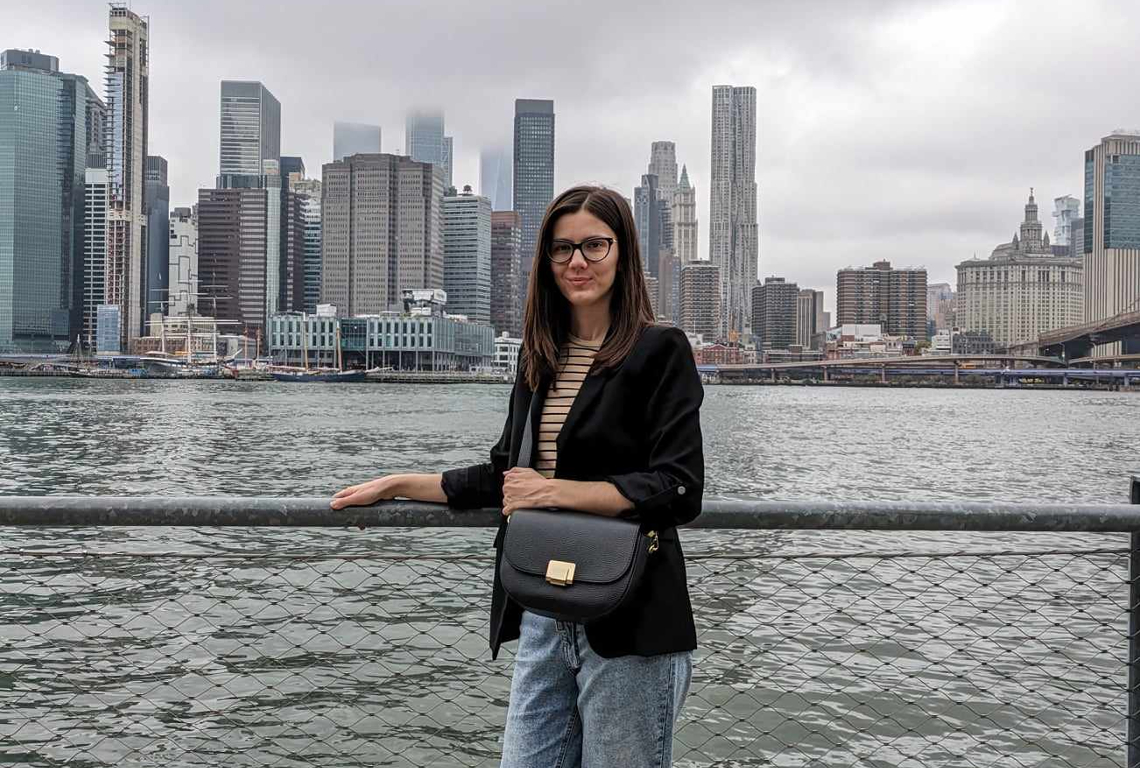
Martina Bábinová Fulfilled Her Dream Thanks to Malý Berlín – She Completed a Residency in New York
It’s been a few weeks since Martina Bábinová returned from the United States. She was there on a curatorial residency that brought her valuable contacts and experience. One of the exhibitions at our Čepan Gallery also resulted from this residency. She shared more in the interview below.
Thanks to Malý Berlín, you got the chance to do an internship – not in Trnava, but all the way in New York. Can you tell us more about how this collaboration came about?
If someone had told me at the beginning of last year that I would spend two months in New York in the fall, I’m not sure I would have believed it. I came across an open call from Malý Berlín for a residency for curators of contemporary art and decided to apply. I still remember the moment I got the email saying I’d been selected. It’s still a small-big dream come true for me.
What was the focus of your stay in New York?
During my stay, I had the opportunity to explore and get to know both the local and international art scenes, build new connections with artists from around the world, and present my curatorial work as well as the activities of the Ernest Zmeták Art Gallery in Nové Zámky, where I currently work. The program at Residency Unlimited focused on networking, collaboration on projects, and public presentations.
Did you make any interesting connections during the residency?
Absolutely, as that was one of the main focuses of the residency. I met many amazing people.
Could you describe in more detail what your days were like during the residency in Brooklyn?
They went by very fast, and each day was different. One of the core weekly activities was studio visits – meetings in studios or at Residency Unlimited with artists who were also in residence at the time. Residency Unlimited offered a variety of programs we could participate in, such as group gallery excursions with guided tours by the exhibition curators, which allowed me to discover many new places. There were also presentations under formats like “Meet Over Lunch” with resident curators, “Talk” sessions with artists, open studios, exhibition openings, and many other events. And then I started checking off all the galleries, museums, and places I wanted to visit. Every day brought new opportunities for inspiration.
What kind of inspiration did you gain in New York in terms of bringing art closer to visitors through educational programs?
Since gallery education is also an area I’m involved in and passionate about, I used my time there to explore various accompanying programs offered alongside exhibitions. I found inspiration in guided tours at the Metropolitan Museum of Art, or the Writing Club at the Museum of Modern Art, which allows visitors to engage with art through creative writing. I also found value in conversations with artists during meetings, particularly about their educational activities – whether at universities, in galleries, or when organizing workshops for the public.
Not long ago, an exhibition took place at Čepan Gallery that bears your curatorial signature. The exhibiting artist was Jelena Micić. How did this collaboration come about?
I first met Jelena during the curatorial residency in New York – she was also there at the time. She was one of the artists I had a studio visit with, during which we discussed her work. I saw some of her pieces in person at an exhibition and was also impressed by her talk at Residency Unlimited, where she spoke about plastic as an everyday part of our lives, its impact and toxicity, and how we are (un)willingly involved in its accumulation. After I returned home, I reached out to her with an offer to collaborate. And since she lives in Vienna, the logistics weren’t complicated to arrange.
Why did you choose this specific theme for the exhibition?
The theme stems from Jelena’s long-term interest in plastics, colors, color systems, and their socio-economic implications. Each artwork reflected a particular approach to collecting, researching, and experimenting with plastic waste materials from everyday life. Jelena deliberately selects, collects, and transforms them into new forms.
The exhibition title Jelena Micić | BASIC FACTS: Orange is red, heart is on the left has a special meaning. Can you tell us more?
I’m not sure I’d call it “special,” but when I was thinking about the title, I wanted it to capture the essence of the artworks without being too straightforward. The goal was for it to intrigue people enough to want to learn more and to include a humorous element reflecting Jelena’s sense of humor. It’s a wordplay that refers to two works presented in the exhibition – one was a spatial ready-made installation titled Bojná polja [Color/Battle fields], created from colorful plastic nets typically used for packaging fruit or vegetables. The other piece was Heart is on the left, made from multicolored garbage bags that Jelena transformed using crochet techniques. The exhibition title references simple, everyday facts that arise from these works – oranges are always packed in red netting, and the human heart is (mostly) located on the left side.
Ján Janočko
Photo: Martina Bábinová’s personal archive